Table of Contents
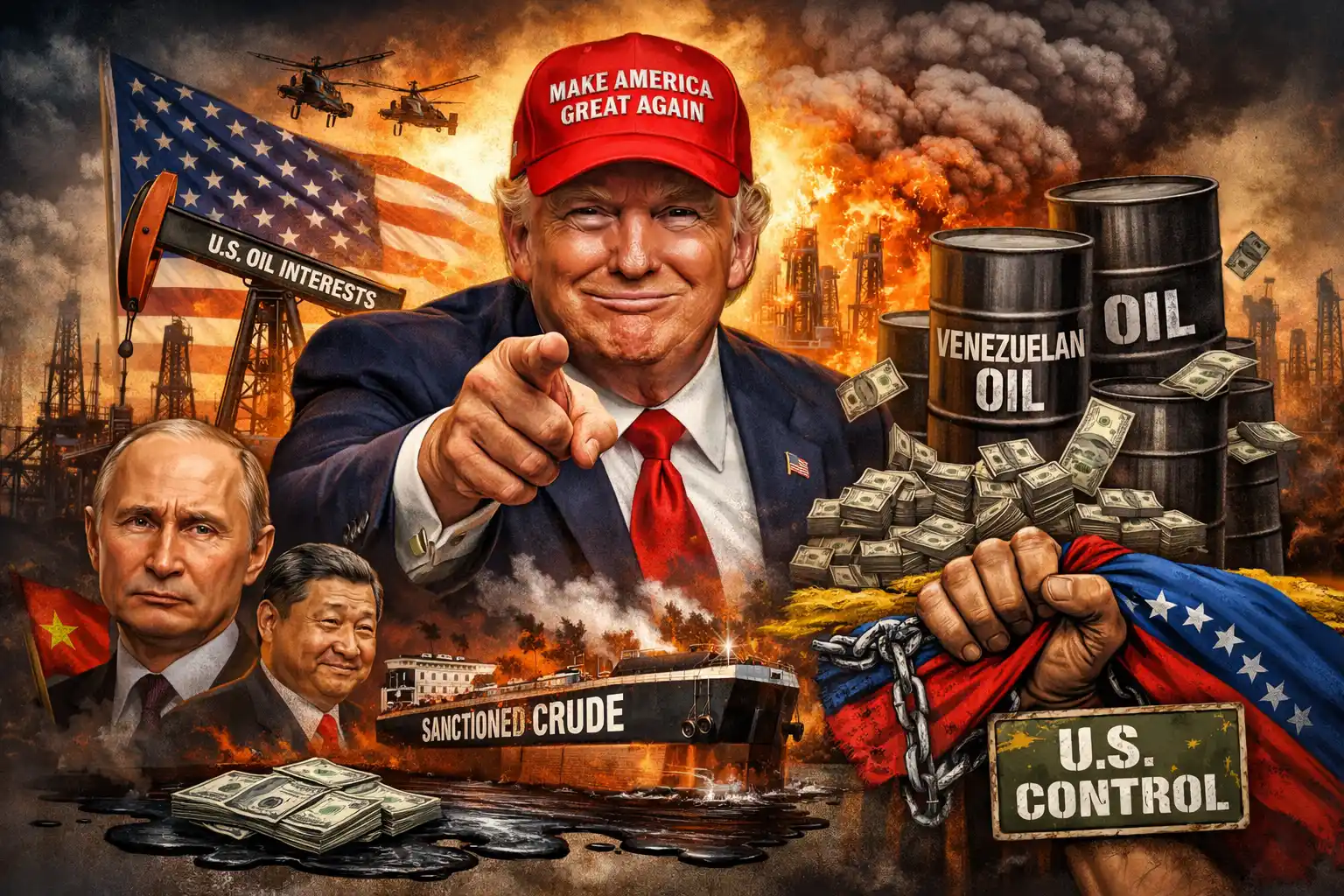
From the very first sentence of his public proclamations, Donald Trump has framed his burgeoning U.S. control of Venezuelan oil reserves as if it were some sort of patriotic energy renaissance rather than what it truly is: grabbing sovereign assets the way a Wall Street raider grabs a distressed company; slide in while a country’s in crisis, extract value, and call it stability.
Donald Trump’s oil strategy is being sold to the world as a win‑win: “freedom for Venezuelans” meets “cheap gas for Americans.” In reality, it reeks of neo‑imperialism, legal legerdemain, and energy realpolitik thinly disguised as good intentions.
The Grand Narrative vs. The Real Narrative
Trump’s Touted Rationale
Trump’s line — and make no mistake, this has been repeated ad nauseam — is that:
- Venezuela’s oil revenue should benefit Venezuelans and Americans.
- Revenue from up to 30-50 million barrels of Venezuelan crude will be controlled by the U.S. administration.
- Blocking creditor claims on these oil funds is “essential for stability.”
- Major U.S. firms (Chevron, ExxonMobil, ConocoPhillips) will come back, invest huge sums to fix Venezuela’s rusting oil infrastructure, and make it profitable again.
Narratively, it’s rescue and rebuild. But strip away the PR speak and you get something much uglier.
The U.S. intends to:
- Treat Venezuela’s oil revenue as something the U.S. government controls, permanently or indefinitely.
- Sell tons of sanctioned crude on the market with the proceeds not transparently going to Venezuela.
- Use this oil as geopolitical leverage against Russia and China, who have historically bought Venezuelan crude.
Legal and Ethical Contortions
Sovereignty? What’s That?
Under international law, oil belongs to the sovereign state in whose soil it sits. This principle, Permanent Sovereignty over Natural Resources, was enshrined decades ago to prevent the exact scenario Washington is engineering now after attacking Venezuela on January 3.
And yet Trump (and advisors like Stephen Miller) have repeatedly claimed that the U.S. has a claim to Venezuela’s oil wealth.
This is the same legal legerdemain used by colonial powers for centuries:
- Claim moral high ground (democracy, stability).
- Invoke security laws (national emergency).
- Grab economic assets while the former owner is incapacitated.
- Call it reconstruction.
If that sounds like sanctioned piracy, it’s because that’s exactly what it is.
Weak Foundations, Strong Rhetoric
Trump’s executive orders don’t suddenly transform Venezuelan oil into a U.S. petrodollar vault. They assert that the funds are sovereign property held by the U.S.
Meanwhile, no credible international adjudication has affirmed U.S. ownership of those assets. Not a single global court has waved a wand and said, yes sir, Trump, go right ahead and keep that oil money.
Instead, what we see is a power play, not a legal solution.
Economics and Energy
Vast Reserves, Tiny Present Output
Yes, Venezuela holds the largest proven oil reserves in the world (over 300 billion barrels).
But here’s the catch every Trump PR feed misses:
- Venezuela currently produces barely 1 million barrels per day, a fraction of its past output of 3.5+ million bpd.
- The oil infrastructure is decrepit, with pipelines and facilities degraded from decades of neglect and sanctions.
- Restoring and expanding production could cost hundreds of billions and a decade of effort.
Sweet talk about cutting US gas prices to $50/barrel by flooding the market with Venezuelan crude ignores this reality: you can’t snap your fingers and reinvent an oil industry that’s been collapsing for years.
Who Really Profits?
This isn’t about cheap gas at the pump for Joe Sixpack. It’s about:
- Lining the pockets of oil majors with juicy contracts.
- Giving U.S. firms guaranteed security and legal shields to invest billions.
- Distributing political patronage to regions tied to fossil fuel capital.
Meanwhile, Venezuelans get the rhetorical crumbs of “reconstruction.” Reality? Outsourced profits with Venezuelan resources subsidizing American energy firms.
And if oil stays cheap? Shale producers go bust. Jobs disappear. The whole miracle oil plan collapses on its own contrived economics.
Geopolitical Impact
America as Global Sheriff or Global Bully?
Trump wants to box out China and Russia.
But here’s the rub: control of Venezuelan oil wards off Beijing and Moscow only if the U.S. can actually manage Venezuelan production.
At present:
- China has longstanding oil ties and deals with Caracas.
- Russia has been a trading partner and military supporter.
- Europe and other nations have skin in the game too.
So the geopolitical impact isn’t just U.S. influence rising: it’s also international tension rising.
This is a flashpoint that could reshape alliances and deepen mistrust toward Washington, especially in Latin America, where memories of Monroe Doctrine–style interference are still raw.
Allies and Enemies: A Zero‑Sum Game
In Trump’s world:
- If we don’t control Venezuelan oil, they (China, Russia) do.
- That’s the logic, but it’s also a manufactured fear designed to justify overreach.
The result?
- A legit pushback from countries seeing U.S. action as classic resource capture.
- A weakening of international norms around sovereignty.
This is realpolitik with a brazen grin, but the world won’t applaud when a superpower walks into a sovereign’s vault and leaves with the keys.
The Plan Isn’t Strategy, It’s Extraction
Trump’s plan for Venezuela’s oil reserves, from executive orders to tankers full of “sanctioned crude” to billion‑dollar investment pitches, is a powerful play anchored in extraction, not enlightenment.
It’s:
- A sovereignty grab dressed as stabilization.
- An economic boondoggle dressed as prosperity.
- A geopolitical power grab masquerading as hemispheric security.
- And an environmental catastrophe dressed as energy independence.
If you strip away the stagecraft, what remains is old‑fashioned resource imperialism for the 21st century, backed by the biggest bully in the room, with the bravado of a reality TV star and the subtlety of a jackhammer.