Table of Contents
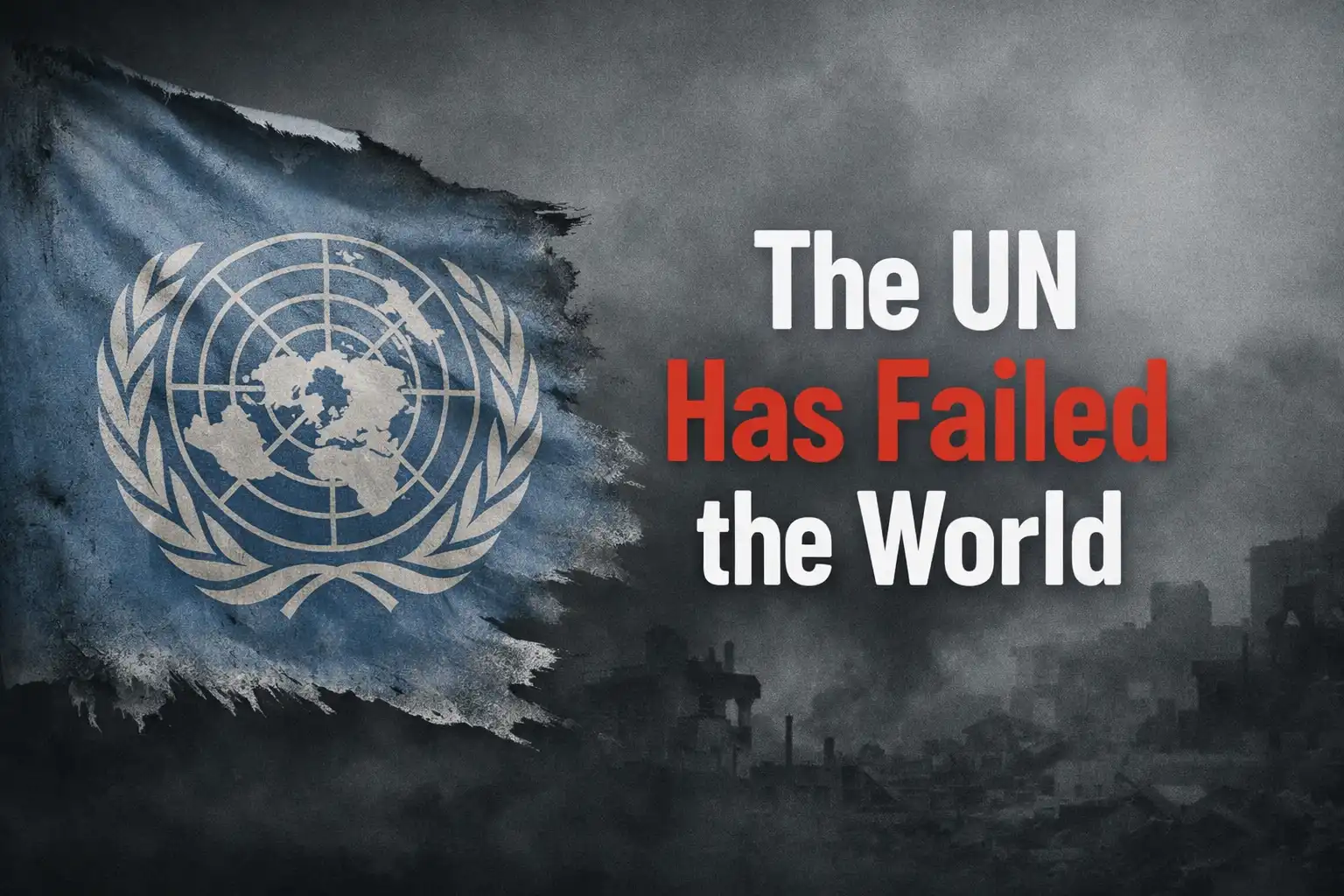
The United Nations was never meant to be loved. It was meant to be endured.
Eighty years after its birth, the UN now exists in a strange limbo: too weak to stop wars that matter, too necessary to be dismantled, too compromised to be trusted, and too embedded in global life to be ignored.
What we are watching is not the sudden failure of the UN, but the slow exposure of what it has always been: a rules-based order designed by the powerful to restrain everyone except themselves.
Recent events have simply torn away the remaining illusions.
Attack on Venezuela
On January 3, 2026, U.S. forces launched a military operation in Venezuela, striking multiple targets and capturing President Nicolás Maduro and his wife in a bold, unprecedented intervention. The mission, dubbed Operation Absolute Resolve, was justified domestically by a U.S. Justice Department memo that argued the president has “inherent constitutional authority” to deploy military force without congressional approval, even if the legality under international law is unresolved.
For half a century, Washington had applied pressure on Caracas through sanctions, diplomatic isolation, and covert support for opposition groups. But this was the first time a Western power’s military seized the sitting leader of a sovereign state in the region.
U.S. officials framed it as part of the fight against narcoterrorism, pointing to Venezuela’s deep corruption and alleged links between the Cartel of the Suns and regional criminal networks.
The operation instantly ignited global controversy:
- See‑world reactions were sharply divided. Some NATO allies welcomed the removal of what they called a repressive and corrupt regime, even if they emphasized the need for diplomacy. Others condemned the act as a violation of international law. China, Russia, Cuba, Brazil, and much of Latin America criticized the attack as hegemonic aggression that undermines sovereignty.
- UN principles were ignored. No Security Council mandate authorized the mission, and the operation violated the core norm against unilateral use of force in another state absent self‑defense. A UN human rights expert formally called the strikes and Maduro’s “abduction” illegal aggression, explicitly condemning U.S. actions as violations of the right to life and sovereignty.
Why does it matter? This was a strategic strike that reset Western hemisphere geopolitics. If military force becomes a legitimate tool to apprehend political leaders absent clear multilateral consent, then the very foundations of post‑WWII international law have shifted.
Iran’s Protests, New Sanctions, and Trump’s Calculus
Almost immediately, the Venezuela operation rippled across the Middle East. Iran, which had condemned Washington’s actions in Caracas, saw mass protests erupt at home, some of the largest anti‑government demonstrations in years, sparked by economic hardship, currency collapse, and a broader anger at clerical rule.
Iran’s government responded with brutal force, and warnings emerged that hundreds have been killed and tens of thousands detained.
In response to both the protests and Iran’s violent suppression, U.S. President Donald Trump publicly supported the protesters, declaring “help is on the way” and hinted at even stronger responses if Tehran continued to kill peaceful demonstrators.
While Tehran claims that calm has been restored, its authorities also signaled plans for fast trials and executions of detainees and vowed retaliation against the U.S. and Israel if attacked.
This dynamic deepens a regional tinderbox:
- U.S. threats and Iranian defiance contribute to heightened regional insecurity. Tehran’s leaders view the Venezuela strike as a possible prelude to similar moves against them.
- Sanctions and tariffs, including new U.S. import tariffs on countries trading with Iran, are squeezing the economy further, worsening domestic suffering.
- Great‑power competition is now playing out not just in capitals but in cities filled with protesters, soldiers, and security forces.
The result is clear: sanctions, threats of force, and military interventions aren’t coercive tools that deliver simple political solutions, they have become accelerants of instability.
Genocide in Gaza & Global Silence That Speaks Volumes
Meanwhile, two years into the Gaza conflict, the humanitarian situation is catastrophic. A UN independent commission concluded that Israel’s actions in Gaza met the legal definition of genocide under the 1948 Convention.
Israel’s military campaign has reduced vast swaths of Gaza to rubble and caused staggering civilian casualties. The conflict also caused a famine during the height of the blockade conditions.
In late 2025 and continuing into 2026:
- Israel implemented a ban on dozens of key aid organizations operating in Gaza, a move UN agencies warned would undermine humanitarian efforts.
- Independent reporting indicates that maternal and neonatal health systems collapsed, with drastic declines in births and severe maternal outcomes.
- Even after a fragile ceasefire, periodic killings continued, and thousands more deaths have occurred, often in zones near ceasefire demarcations.
And yet, the global response has been muted. Western capitals that loudly condemn Russia or Syria for human rights violations have mostly avoided forceful censure of Israel’s conduct or calls for accountability proportionate to the scale of suffering.
Domestic politics and powerful lobbies shape foreign policy in ways that lead to silence or selective outrage, even as international institutions like the ICC have issued arrest warrants related to war crimes, including charges regarding starvation as a weapon of war.
This selective silence fractures the credibility of international norms. If mass civilian deaths, famine conditions, and systematic destruction can occur without cohesive global legal pushback, then the rules against genocide risk becoming hollow.
The UN’s Dilemma: Paralyzed, Uneven, and Under Strain
What connects Venezuela, Iran, and Gaza is not just geopolitical tension, it’s the failure of multilateral institutions to enforce the rules they are supposed to uphold.
The UN Security Council remains powerless to check unilateral military interventions when a permanent member, in this case, the United States, is directly involved. Previous designs intended to prevent such unilateralism have collapsed under political reality.
This is a procedural flaw and reveals a deeper truth: great powers now act with impunity when their interests are at stake, and they expect international law to apply selectively to others.
The consequences include:
- A new norm of unilateral force, evident in Caracas and threatened in Tehran, detached from Security Council authority.
- A double standard on humanitarian catastrophe, with genocide in Gaza while many governments hesitate to act.
- Sanctions wielded as geopolitical weapons, shaping domestic suffering in targeted states without delivering stable political outcomes.
In such a world, the UN, once envisioned as the guardian of peace and human rights, is instead reduced to a forum where powerful states block accountability for themselves and each other.
The Fractured World
Looking at these three crises together, a pattern emerges:
- Might overrides law when great powers choose it.
- Selective outrage corrodes legitimacy and fosters cynicism about international norms.
- Human suffering becomes a bargaining chip in geopolitical chess.
And yet, as flawed as the system is, abandoning multilateral mechanisms entirely would invite even greater disorder. The answer is not nostalgia for a golden age of global cooperation.
That age never existed!
But a candid reckoning with how power has reasserted itself over law. When powerful states see law as optional, weaker states pay the cost in bombs and blockades, in sanctions and silences.
In Need of New Principles
The crises in Venezuela, Iran, and Gaza are not random or disconnected. They are symptoms of a world where international norms have been hollowed out by geopolitics, and where the powerful act as if they are above the rules they once helped write.
Whether the UN can reform itself, or whether a new system will emerge from the fractures of the current one, remains an open question. But until we confront the uncomfortable reality that law alone does not restrain power, and that selective enforcement destroys legitimacy, the international order will continue to be defined by conflict, not peace.