Table of Contents
Since late December 2025, Iran has experienced widespread protests stretching into January 2026. Demonstrations began among bazaar merchants and small business owners in Tehran over economic pressures, including a rapidly falling currency and sharp inflation.
The unrest has expanded nationwide, with observers and local monitoring groups reporting protests in numerous cities and provinces across Iran, including Tehran, Mashhad, Isfahan, Shiraz, and others.
Casualty and detention figures vary by source, but hundreds of deaths and thousands of arrests have been reported in association with clashes between protestors and security forces. Communications disruptions, including widespread internet shutdowns, complicate independent verification of these figures.
Western media frames potential U.S. intervention as humanitarian; reality is uglier and far more strategic.
But here’s the twist: if the U.S. actually intervenes militarily, whether under the hashtag #ProtectProtesters or to neuter Iran’s weapons program, it will be doing so not out of altruism but to preserve hegemony, energy leverage, and the regional order favorable to Israel and Gulf allies. History shows these are never humanitarian missions.
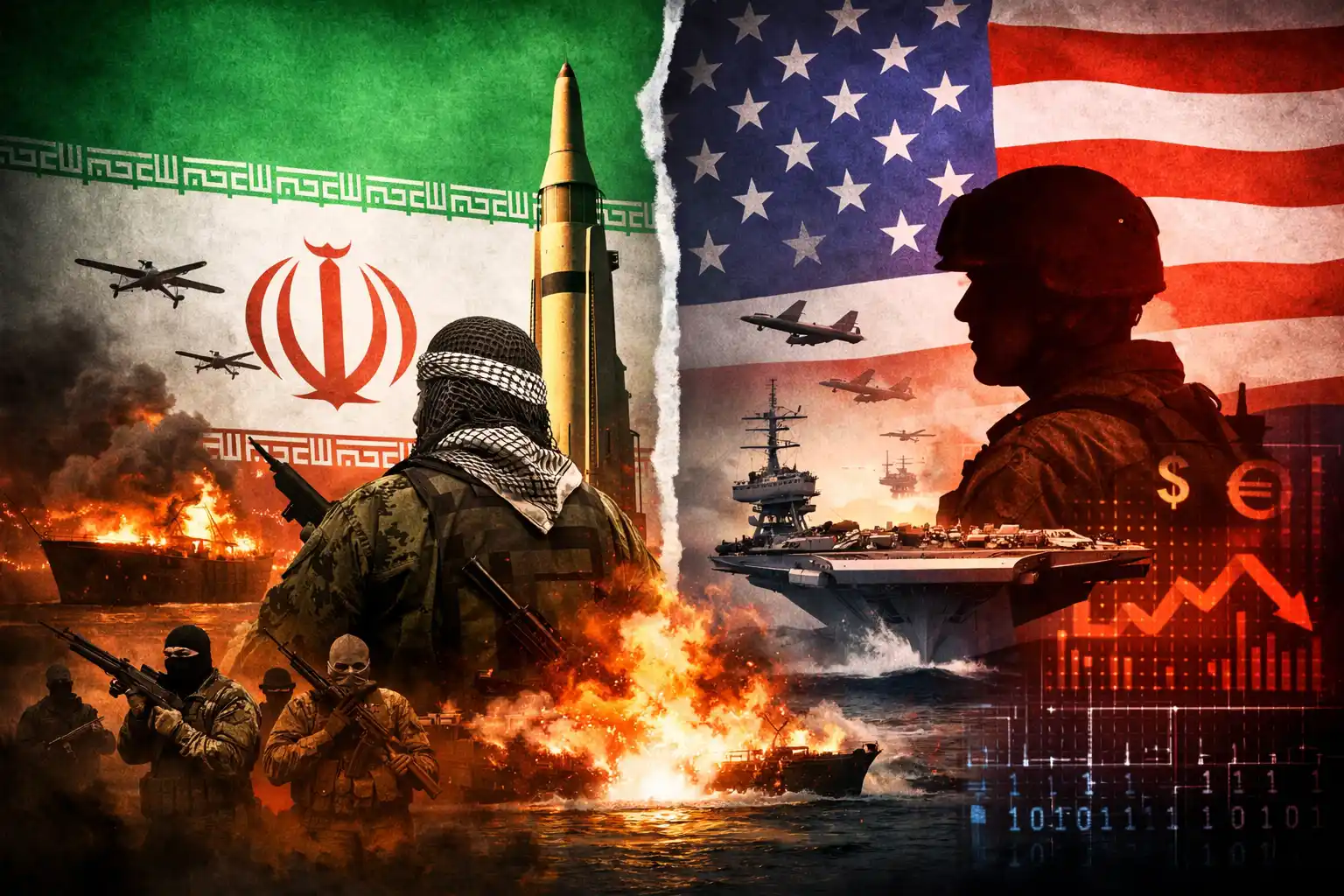
Iran is not a passive victim waiting for Western salvation. It possesses a multi‑dimensional arsenal; ideological, military, economic, and asymmetric, to retaliate far beyond its own borders.
Why U.S. Intervention Is Both Likely and Unlikely
The U.S. has been threatening Iran for decades with sanctions, covert ops, drone strikes, assassination of commanders, all while claiming they only want peace. The U.S. seeks regional dominance and control over strategic energy corridors. Iran’s existence as an independent actor undermines that.
Yet intervention is not guaranteed, not because Iran has suddenly become lovable or compliant, but because:
- Military engagement with Iran is not a quick, sanitized operation like the attack on Venezuela on January 3. Iran has missiles, proxies, and geography that can make any war Hell on Earth.
- Global economics, especially oil markets, would be immediately devastated by disruption of the Strait of Hormuz. Even the U.S. economy is vulnerable here.
- U.S. domestic politics are fractious; costly foreign wars don’t play well with voters who already blame Washington for stagnating living standards.
So the U.S. could strike but only if political pressure, domestic optics, and strategic calculations align, which they rarely do, unless the goal is much broader than the public is told.
Iran’s Retaliatory Toolbox
If America strikes Iran militarily, especially its nuclear or military infrastructure, Tehran has multiple ways to hit back. These are rooted in recent analyses and regional developments:
1. Military Response: Conventional + Asymmetric
Iran doesn’t have a shiny modern air force, but it does have:
- Ballistic and cruise missiles aimed at U.S. bases and Gulf partners.
- Naval disruption capabilities in the Persian Gulf.
- Unmanned systems and anti‑access/area denial tactics that make any intervention costly.
- Key decision‑makers in Tehran have openly threatened to make U.S. installations legitimate targets if America escalates.
This isn’t Saddam in 1991 where Iraq had poor continuation capacity; Iran has decades of asymmetric preparation and a strategic doctrine of denial, not pure attrition warfare.
2. Economic & Energy Warfare
Iran could:
- Throttle the Strait of Hormuz, which channels roughly a third of the world’s oil. Mines, speedboats, and naval harassment are cheap ways to crash markets.
- Mobilize networks to disrupt shipping in the Red Sea and Bab al‑Mandab.
- Use its oil exports (sanctions permitting) as leverage over major importers like China, India, and Europe.
This is the kind of retaliation that hurts the West’s wallet without firing a shot at American soil.
3. Cyber & Information Warfare
Iran’s evolving cyberspace capability, developed alongside allies like China and Russia, allows it to:
- Strike critical infrastructure.
- Paralyze financial networks.
- Manipulate information flows to sow confusion and undermine Western unity.
Tehran has invested heavily in cyber units precisely for conflicts like this.
4. Proxy Networks — The Asymmetric Multiplier
Forget the old “Iran as monolithic state” narrative. Tehran controls/backs a web of fighters capable of striking U.S. interests:
- Hezbollah (Lebanon)
- Shia militias (Iraq)
- Houthi factions (Yemen)
- Missions can be escalated without direct Iranian boots on the ground.
Attack U.S. bases in Iraq? Kidnap Westerners? Harass shipping routes? All of these are plausible and have precedent.
5. Nuclear Ambiguity as Coercive Leverage
If pushed to the brink, Iran could:
- Accelerate enrichment.
- Reject international inspectors.
- Use nuclear ambiguity to ensure no effective counter‑strike.
This isn’t “Iran goes nuclear” propaganda; it’s strategic ambiguity, similar to Israel, but the West refuses to criticize its own allies.
Why Tehran’s Response Would Be Brutal
Iran doesn’t have the luxury to show weakness. Its leadership has explicitly warned that any foreign intervention will be answered with force and decisiveness.
Iran interprets Western threats as existential. That means:
- Retaliation won’t be limited: it will be designed to impose costs far beyond the battlefield.
- Regional escalation becomes organic: other actors (like Hezbollah or Houthis) don’t need Iran’s command to strike when Tehran is perceived under attack.
- Global leverage, especially energy security, becomes a weapon against the North Atlantic elites who think they can bomb their way to stability.
U.S. & Israeli Hypocrisy
Every U.S. official who mouths “protect the people of Iran” is repeating a script learned in Washington PR classes. Pressing political elites cheer when military budgets swell, lobbyists dance, and arms contractors post record profits.
Let’s be brutally honest:
- The U.S. claims humanitarian motives but has spent decades bombing, sanctioning, and regime‑changing foreign societies while ignoring similar abuses by allies.
- Israel claims existential threats from Iran but expands settlements and massacres civilians, including children, in Gaza.
Both nations leverage moral language to justify strategic dominance, not ethical consistency.
Scenario Analysis
Let’s map realistic paths:
Best Case: Limited Escalation
The U.S. threatens action, Iran blusters, diplomatic back‑channels cool tempers. No major strikes. Result: status quo with higher prices at the pump.
Most Likely: Multi‑Domain Retaliation
U.S. limited strikes → Iranian counters via missiles, proxies, cyber → global energy disruptions → coalition fractures over cost and casualty aversion.
This path ensures the conflict becomes too expensive to win but too complex to end quickly.
Worst Case: Regional War Spiral
U.S. strikes ↔ Iran escalates ↔ Hezbollah and proxies join in ↔ wider Gulf states pulled in ↔ global markets crash, alliances fray.
This is not far‑fetched: we’ve seen echoes of this pattern since the 2000s.
Final Remarks: Western Hubris Meets Iranian Realpolitik
The belief that Western intervention would be a surgical, tidy operation with moral clarity is pure fantasy. If the U.S. intervenes in Iran:
- Tehran will retaliate on multiple fronts: military, economic, cyber, and through proxies.
- The conflict would not stay “contained.”
- The West’s moral justification would collapse under its own cynicism.
Underestimating Iran’s strategic depth and regional leverage is not just naive, it’s dangerous. The next time Washington talks about liberating Iranians, ask instead: liberating whose interests?